





When a tense email lands or your heart starts racing before a presentation, you need something that works in seconds, not minutes. The physiological sigh is the closest thing to an off-switch for stress that most of us carry everywhere.
What is a physiological sigh?
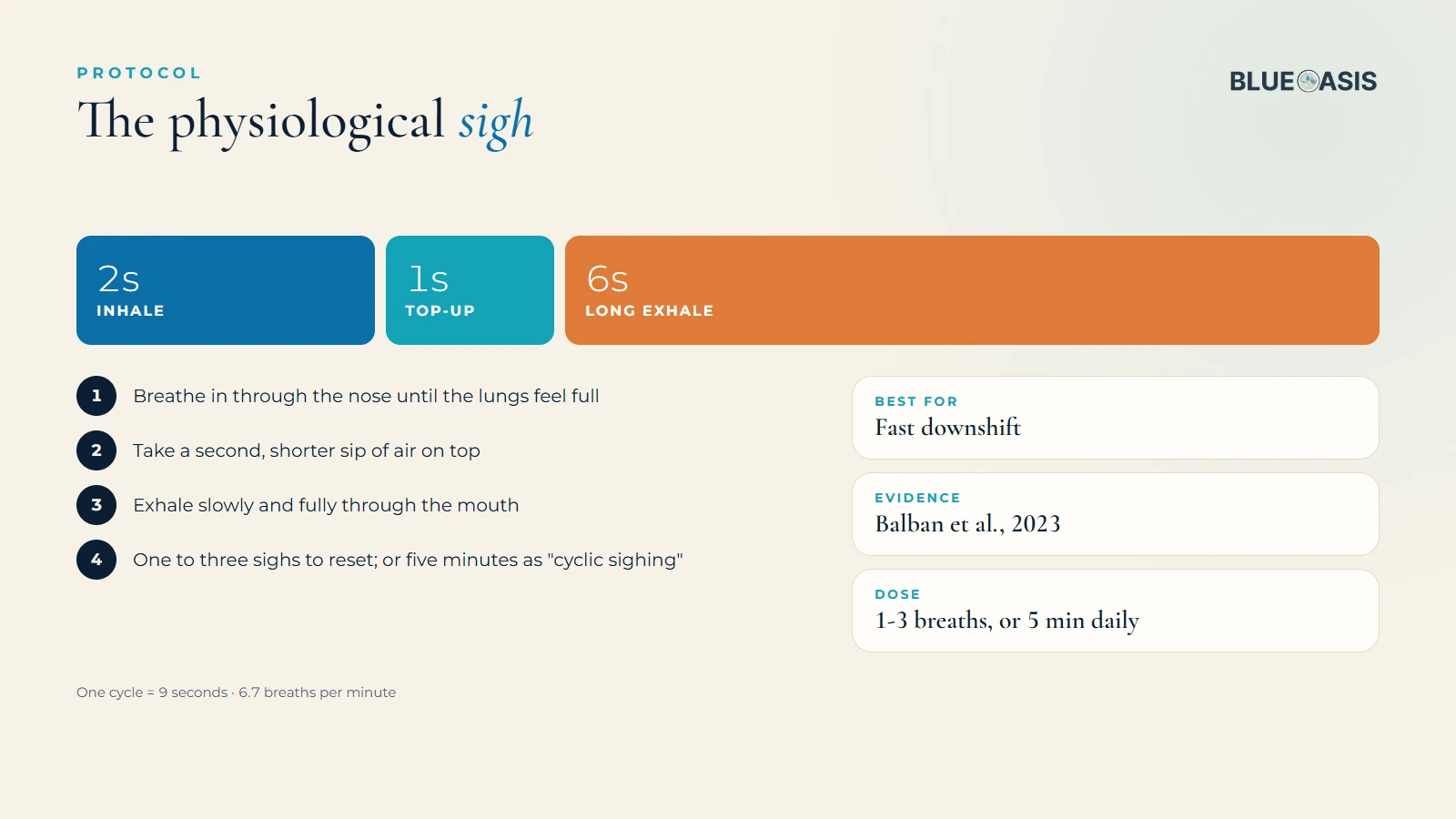
It is a double inhale through the nose, the second a short top-up, followed by a long, slow exhale through the mouth. Humans and other mammals sigh spontaneously every few minutes; the extra inhale reinflates tiny air sacs in the lungs, and the long exhale gives the vagal brake on the heart more time to engage.
What the research found
In a 2023 randomised trial in Cell Reports Medicine, researchers at Stanford asked adults to practise for five minutes a day for a month. They compared three breathing techniques (cyclic sighing, box breathing and cyclic hyperventilation) with mindfulness meditation. All four improved mood, but the breathing groups improved positive mood more than mindfulness, and cyclic sighing, simply repeating physiological sighs for five minutes, produced the largest effect and the largest drop in resting breathing rate.
How to use it
- In the moment: one to three sighs, before you reply to a message, at a red light, before you walk into a room.
- As daily training: five minutes of cyclic sighing, at the same time each day.
Why the exhale matters
Your heart speeds up slightly as you breathe in and slows as you breathe out. Lengthening the exhale tips the balance toward the brake. The same principle underlies resonance breathing, the long-exhale "4-7-8" pattern and humming.
Breathe gently. If you feel dizzy, stop and breathe normally. Never practise fast breathing or breath holds in or near water.
The Online Tribe's Breathwork module teaches five protocols, when to use each, and a two-week plan to make them automatic.
Sources
- Balban MY, Neri E, Kogon MM, et al. Brief structured respiration practices enhance mood and reduce physiological arousal. Cell Reports Medicine. 2023;4(1):100895. Link
- Zaccaro A, Piarulli A, Laurino M, et al. How breath-control can change your life: a systematic review on psycho-physiological correlates of slow breathing. Frontiers in Human Neuroscience. 2018;12:353. Link
- Russo MA, Santarelli DM, O'Rourke D. The physiological effects of slow breathing in the healthy human. Breathe. 2017;13(4):298-309. Link

Dayna Hale
The visionary behind Blue Oasis Life, Dayna curates unparalleled holistic experiences for high-performing individuals.



Comments
0 comments