





If you wear a smartwatch or a ring, you have probably seen a number called HRV. It is one of the most useful windows into your nervous system that you can measure at home, and one of the most misunderstood. This guide explains what heart rate variability is, what it can and cannot tell you, and the evidence-based ways to improve it.
What is heart rate variability?
Your heart rate is an average. At 60 beats per minute, the gap between beats is not exactly one second every time; one interval might be 1.02 seconds, the next 0.94. Heart rate variability is simply how much those intervals vary. Far from being a fault, that variation is a sign of a responsive heart, adjusted beat by beat by a running conversation between the accelerator (sympathetic nerves) and the brake (the vagus nerve).
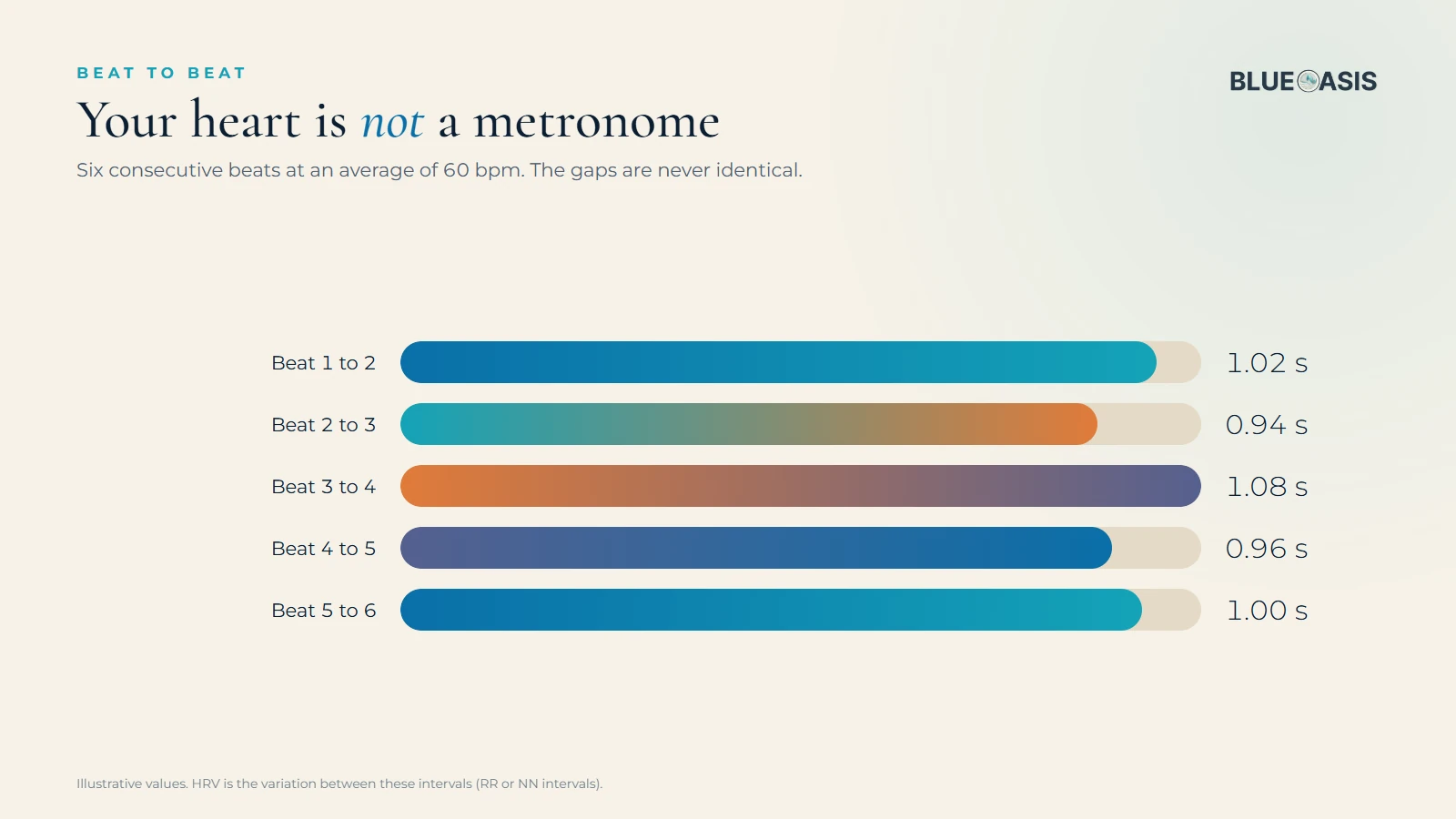
Much of the fast, beat-to-beat variation at rest is driven by the vagus nerve, which is why short-term measures such as RMSSD are widely used as an index of parasympathetic activity. Higher resting HRV generally reflects a stronger vagal brake and a more adaptable system.
What moves your HRV
- Down: alcohol (often for one or two nights), short or late sleep, hard training without recovery, illness (often before symptoms), ongoing stress and jet lag.
- Up: consistent sleep, aerobic fitness built over months, slow breathing practice, recovery days and time in nature.
HRV also falls with age and varies enormously between people because of genetics. Two healthy people of the same age can have resting values that differ several-fold, so comparing yours with a friend's tells you very little.
How to measure it properly
- Use one device and stick with it. Chest straps are most accurate; rings and watches are good for overnight averages.
- Measure at the same time each morning, in the same position, breathing normally.
- Read the rolling 7-day average, not single days. One low morning after a late dinner is noise; a falling weekly average with a rising resting heart rate is a signal.
How to raise it: resonance breathing
The most direct way to enlarge HRV is to breathe slowly, at around six breaths per minute (for example, in for four seconds and out for six). At that pace, breathing and the blood-pressure reflex reinforce each other, producing large, smooth heart rhythm waves that researchers call resonance. A 2017 meta-analysis of HRV biofeedback found large reductions in self-reported stress and anxiety.
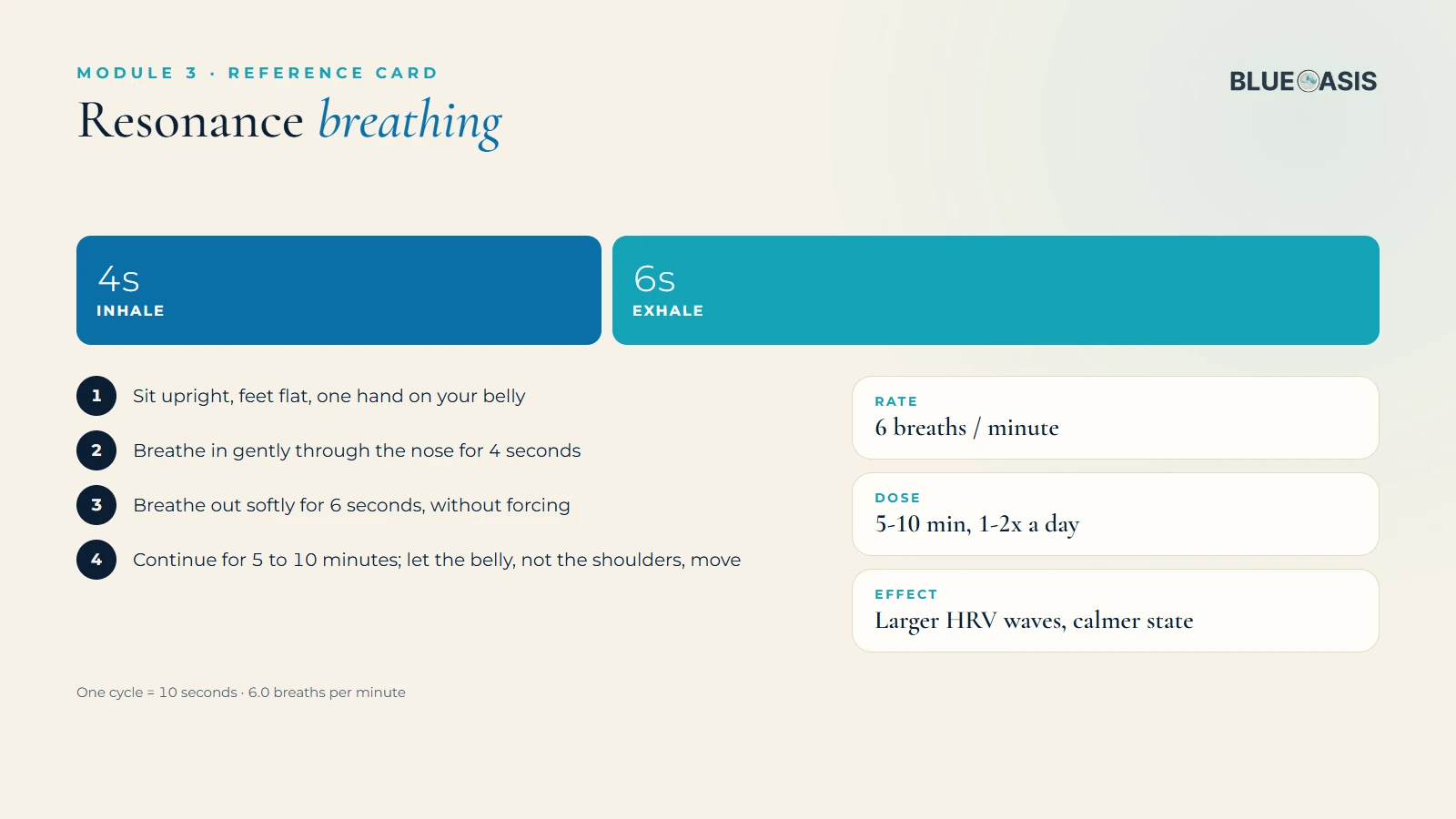
Five to ten minutes a day is enough to start. Over weeks, many people see their morning average stabilise or rise, and, more importantly, they recover faster after stressful moments.
In The Online Tribe, Module 3 walks you through measuring your HRV, finding your personal resonance rate and logging 30 days of data, with live biofeedback Q&A sessions every month.
Sources
- Shaffer F, Ginsberg JP. An overview of heart rate variability metrics and norms. Frontiers in Public Health. 2017;5:258. Link
- Lehrer PM, Gevirtz R. Heart rate variability biofeedback: how and why does it work? Frontiers in Psychology. 2014;5:756. Link
- Goessl VC, Curtiss JE, Hofmann SG. The effect of heart rate variability biofeedback training on stress and anxiety: a meta-analysis. Psychological Medicine. 2017;47(15):2578-2586. Link
- Plews DJ, Laursen PB, Stanley J, Kilding AE, Buchheit M. Training adaptation and heart rate variability in elite endurance athletes: opening the door to effective monitoring. Sports Medicine. 2013;43(9):773-781. Link

Dayna Hale
The visionary behind Blue Oasis Life, Dayna curates unparalleled holistic experiences for high-performing individuals.



Comments
0 comments