




A plane can carry you across eight time zones in a day. Your body clock moves roughly one zone a day. For frequent long-haul travellers, the resulting jet lag is not an occasional nuisance but a permanent tax on sleep, mood and judgement. The good news: it follows rules you can use.
Why east is harder than west
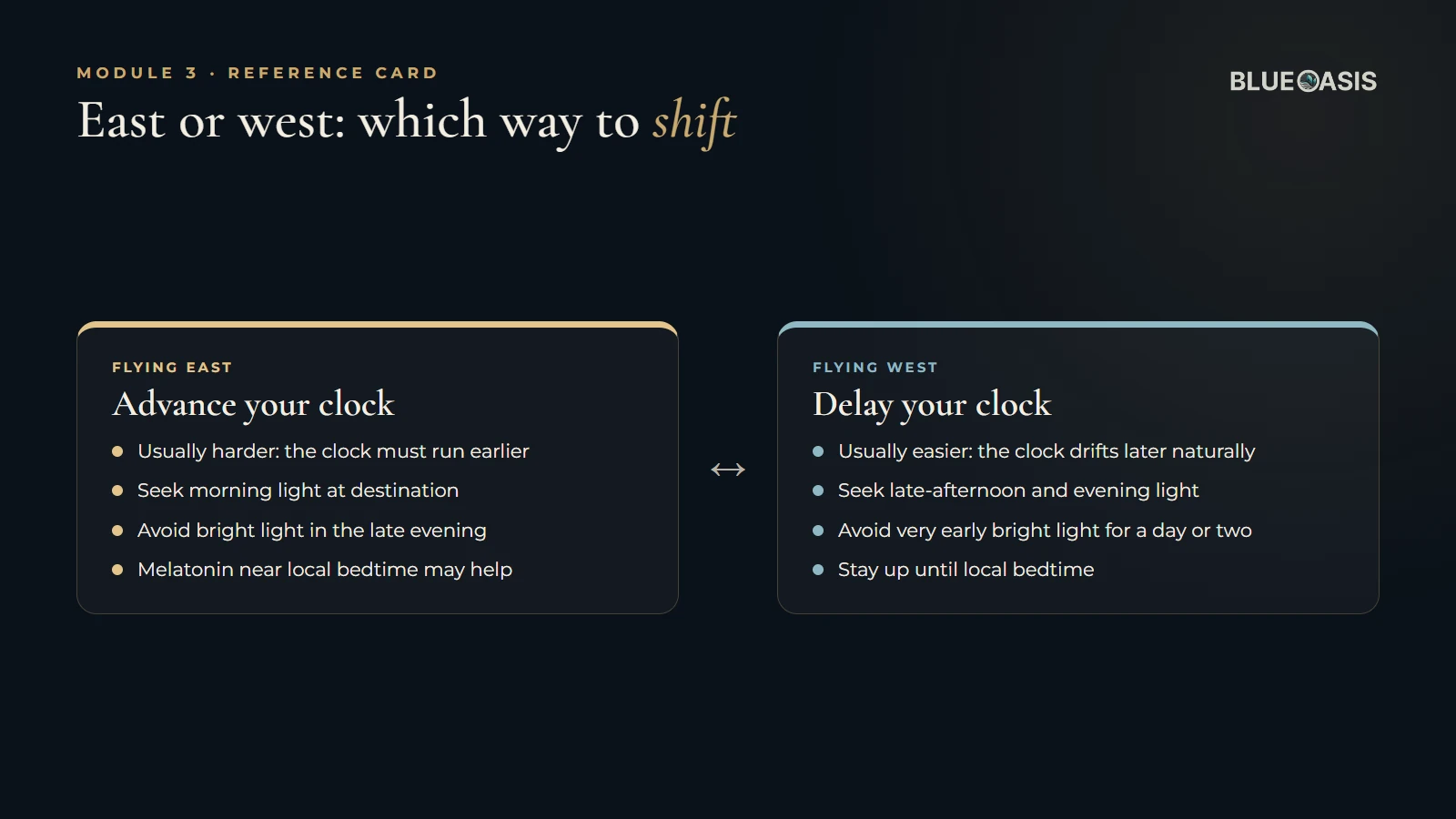
Most people's internal day is slightly longer than 24 hours, so the clock drifts later easily but resists running earlier. Flying west asks it to delay, which it finds easy; flying east asks it to advance, which it resists.
Light is the steering wheel, if the timing is right
Experiments mapping the human "phase response curve" show that light before your body's low point (usually two to three hours before your normal wake time) shifts the clock later, while light after it shifts the clock earlier. That is why "get morning sun" can backfire after a big eastward trip: early local light may land in your biological night.
The protocol
- Short trip (under about three days)? Consider staying on home time and scheduling key meetings in your biological daytime.
- Eastbound: go to bed and wake an hour earlier for a few days before you fly, with bright light soon after waking. At the destination, seek late-morning light and avoid bright light late in the evening.
- Westbound: get outside in the afternoon and evening, wear sunglasses against very early light for a day or two, and stay up until local bedtime.
- Melatonin: a Cochrane review found melatonin near the target bedtime at the destination reduced jet lag for most travellers crossing five or more time zones, especially eastward. Discuss dose and timing with your doctor.
Flight day
- Set your watch to destination time when you board, and eat and sleep accordingly.
- Cabins are pressurised to the equivalent of up to about 8,000 feet and are very dry: drink water, keep alcohol minimal.
- Pump your calves hourly and walk the aisle.
- Use five minutes of slow breathing after take-off and before landing.
VIP Global Travel members receive a personal jet lag protocol for every trip, planned by their concierge with biofeedback specialist Cesar Rueda.
Sources
- Eastman CI, Burgess HJ. How to travel the world without jet lag. Sleep Medicine Clinics. 2009;4(2):241-255. Link
- Khalsa SBS, Jewett ME, Cajochen C, Czeisler CA. A phase response curve to single bright light pulses in human subjects. Journal of Physiology. 2003;549(3):945-952. Link
- Herxheimer A, Petrie KJ. Melatonin for the prevention and treatment of jet lag. Cochrane Database of Systematic Reviews. 2002;(2):CD001520. Link
- NHS. Jet lag. nhs.uk (accessed 2026). Link

Dayna Hale
The visionary behind Blue Oasis Life, Dayna curates unparalleled holistic experiences for high-performing individuals.

Comments
0 comments