





"Am I calm, wired or shut down?" Learning to answer that question quickly is one of the most practical skills in stress management. Two maps make it easier: the polyvagal ladder and the window of tolerance.
The polyvagal ladder
In the 1990s, neuroscientist Stephen Porges proposed polyvagal theory, describing three broad patterns of autonomic response. Therapist Deb Dana turned them into an image: a ladder with safe and social at the top, fight or flight in the middle and shutdown at the bottom.
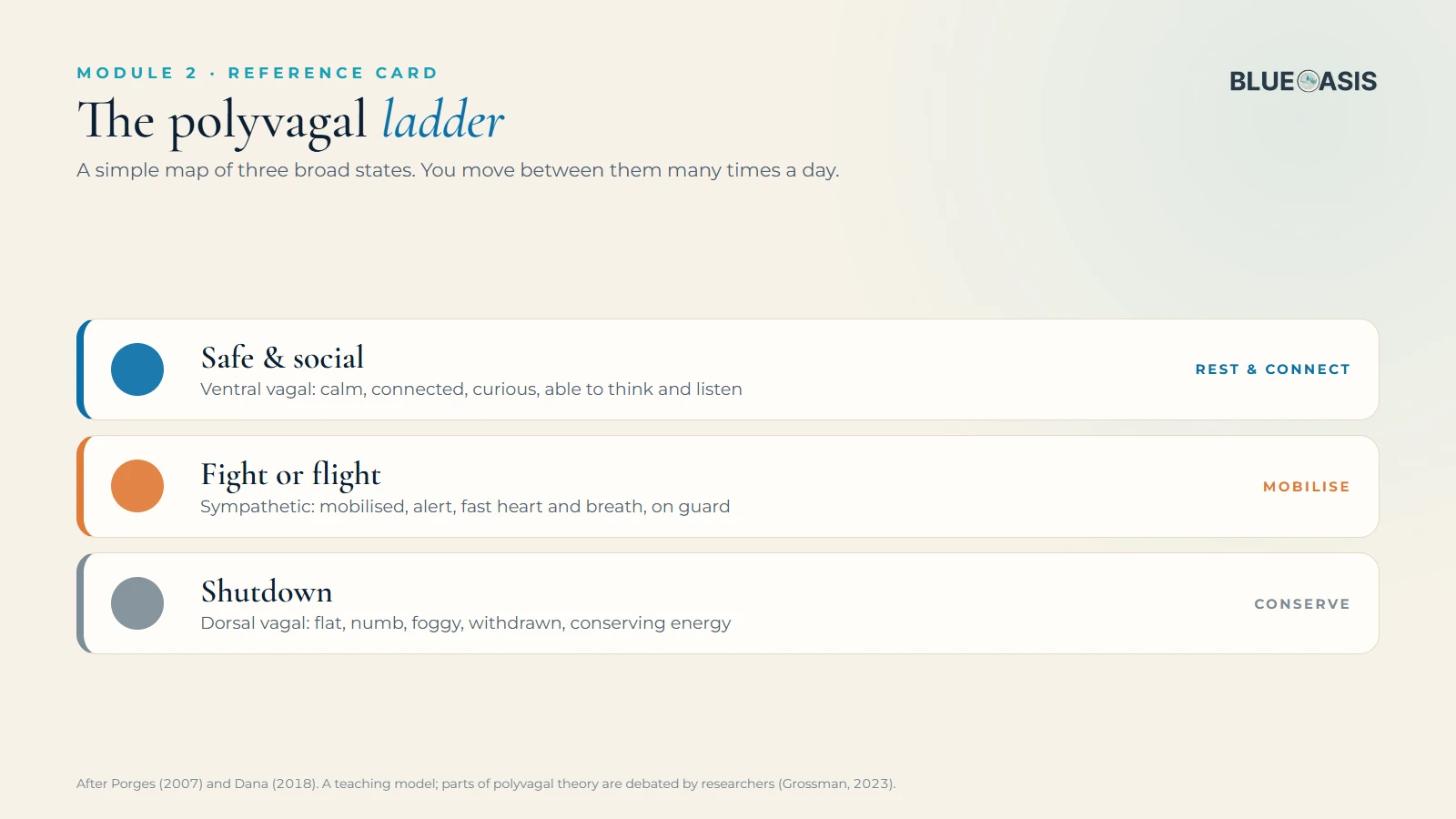
Two ideas are especially useful. Neuroception: your nervous system detects safety and danger below awareness, which is why you can feel tense before you know why. And climbing in order: from shutdown, the route back to calm often passes through a little movement first.
An honest note on the science
Polyvagal theory is widely used in therapy and coaching, but researchers continue to debate parts of it, particularly its evolutionary claims and how specific vagal pathways map onto states. The ladder is best used as a language for experience, not as anatomy, and paired with things you can measure, such as heart rate variability.
The window of tolerance
Psychiatrist Daniel Siegel described the window of tolerance: the zone in which you can feel strong emotion and still think, listen and choose. Above it you are flooded; below it you are numb.
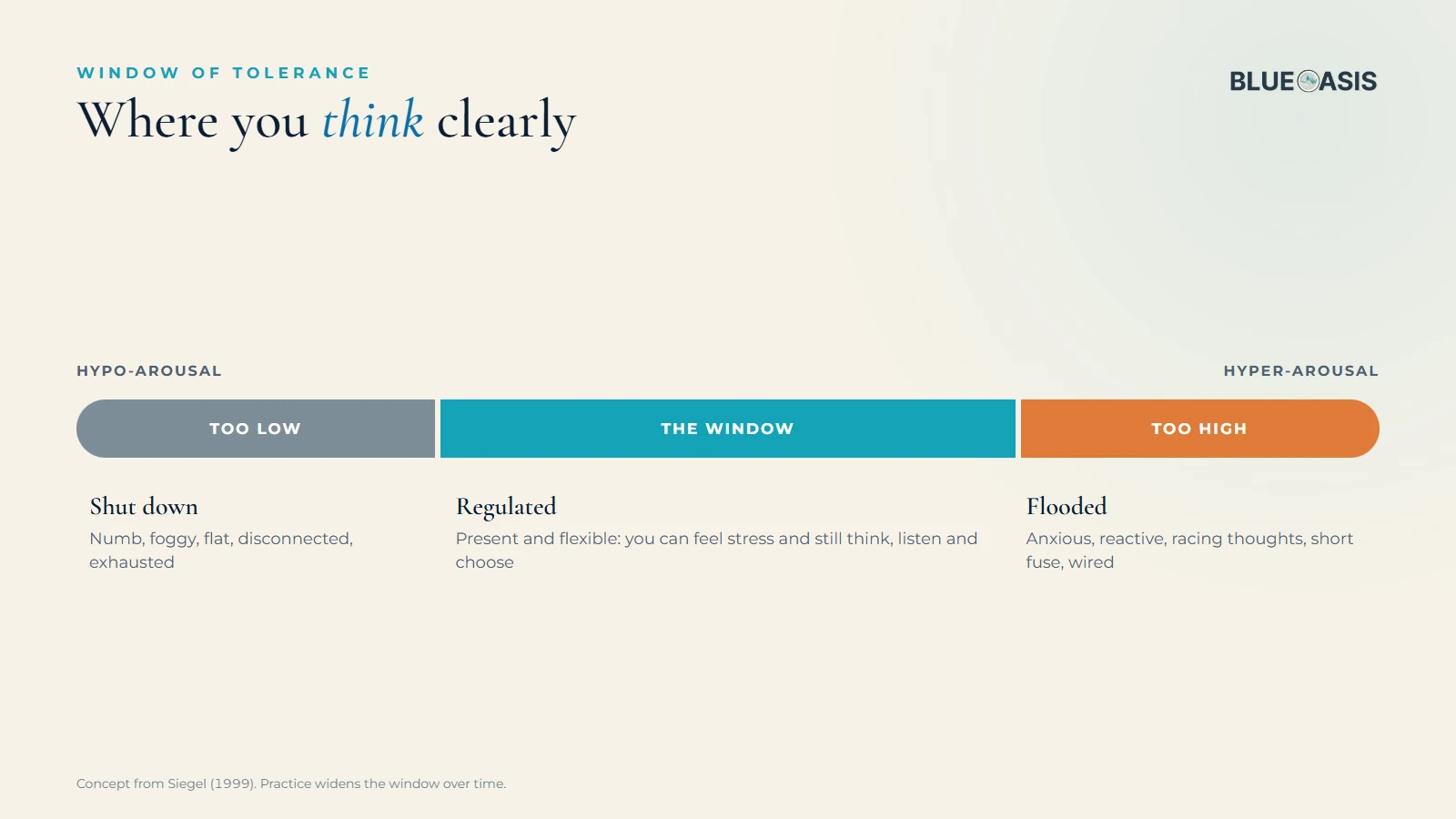
Sleep loss, hunger, illness and chronic stress narrow the window; rest, connection and daily practice widen it.
Three ways back up the ladder
- Orient: slowly look around and name five things you can see.
- Exhale: in for four, out for seven, five times.
- Connect: a friendly face or voice is one of the fastest safety signals there is.
Module 2 of The Online Tribe includes a Nervous System Field Guide to map your states, triggers and glimmers.
Sources
- Porges SW. The polyvagal perspective. Biological Psychology. 2007;74(2):116-143. Link
- Grossman P. Fundamental challenges and likely refutations of the five basic premises of the polyvagal theory. Biological Psychology. 2023;180:108589. Link
- Dana D. The Polyvagal Theory in Therapy: Engaging the Rhythm of Regulation. W. W. Norton; 2018. Link
- Siegel DJ. The Developing Mind (2nd ed.). Guilford Press; 2012. Source of the "window of tolerance" concept. Link

Dayna Hale
The visionary behind Blue Oasis Life, Dayna curates unparalleled holistic experiences for high-performing individuals.



Comments
0 comments